Experiment 01
Individual Perspectives Tool
Built for Collective Next using Replit AI
In-person facilitation workshops always had the same problem: collecting group inputs, synthesizing them, and aligning thinking meant jumping between a dozen different tools. I built one environment to do all of it.
The Problem
Large-group workshops generate a lot of signal. Getting from raw participant responses to a coherent, actionable brief, in real time, during a live event, used to require stitching together multiple tools and a lot of manual effort. The ask was to make that process faster, cleaner, and repeatable across different clients and events.
What I Built
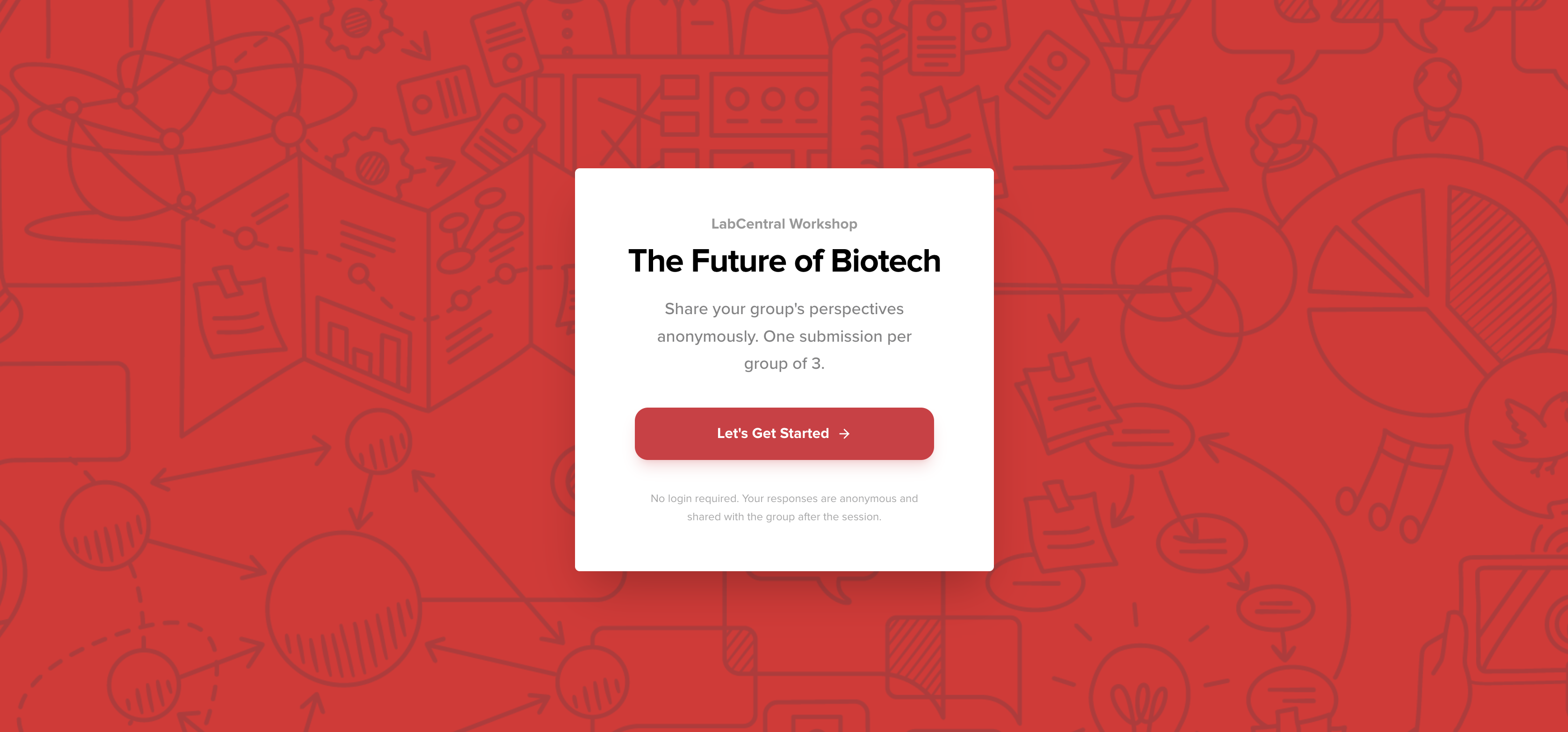
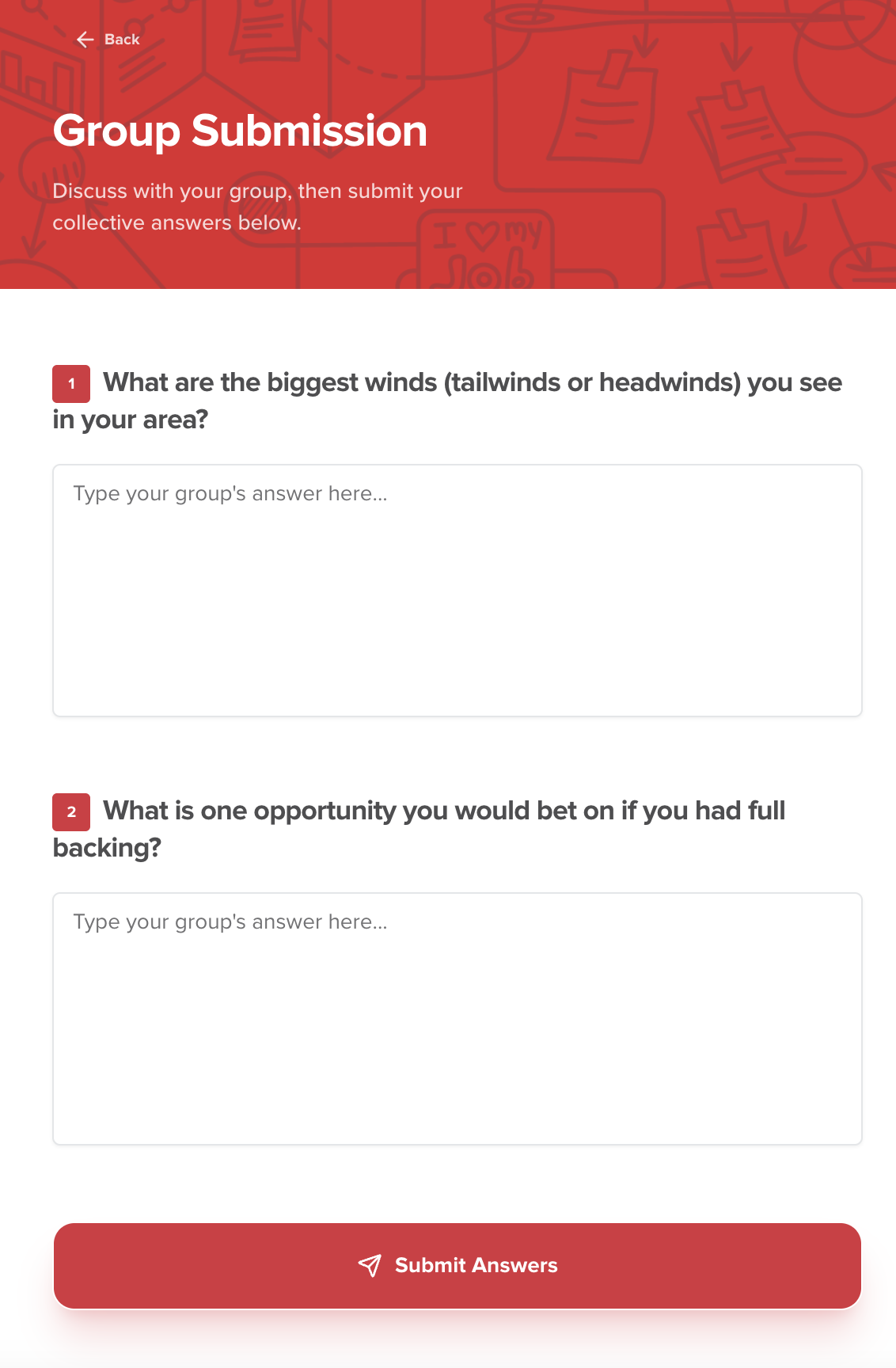
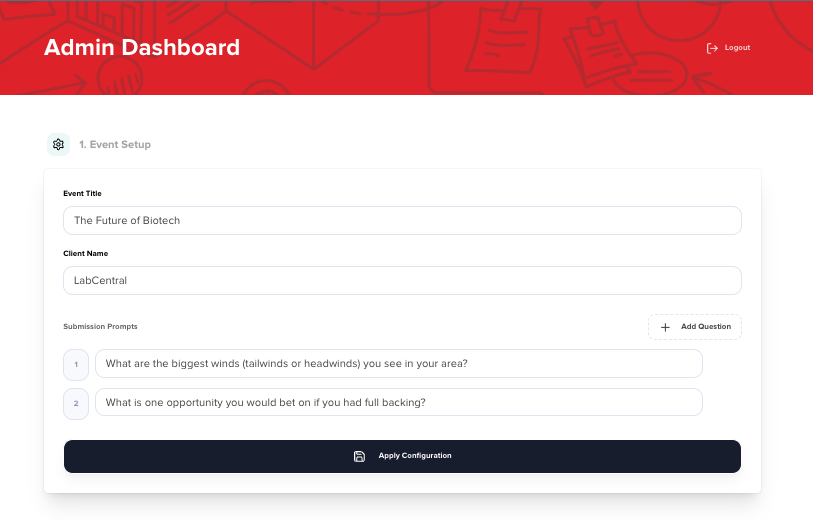
Participants scan a link, submit anonymous responses in groups of three. No logins, no friction. On the back end, an admin dashboard gives the event runner full control: configure prompts, watch responses come in live, trigger an AI synthesis, and publish a structured brief directly to participants' screens in one click.
The admin dashboard is the real product. It makes the tool repeatable across any client, any prompt, any event without touching the code. Combined with a fully reskinnable UI, the same app can show up as one brand experience one week and a completely different one the next.
Every line of this app came out of a conversation. No dev team, no sprints. Just a clear product vision translated into a working web app through precise prompting. The database, server logic, AI pipeline, UI, and branding all came from knowing exactly what I needed and being able to describe it clearly.
The admin dashboard is the real product. It makes the tool repeatable across any client, any prompt, any event without touching the code. Combined with a fully reskinnable UI, the same app can show up as one brand experience one week and a completely different one the next.
Every line of this app came out of a conversation. No dev team, no sprints. Just a clear product vision translated into a working web app through precise prompting. The database, server logic, AI pipeline, UI, and branding all came from knowing exactly what I needed and being able to describe it clearly.
What I Learned
Specificity is the actual skill. Generic prompts get generic results. What made this work was bringing a real problem, a real audience, and real constraints into the process. The AI is the tool. Knowing what to build and being able to articulate it with enough clarity and taste to get it right, that's the designer's job. Turns out it translates.
Why It Matters
The real value of AI in design isn't speed for its own sake. It's what speed makes possible. A tool like this used to require a dev team, a sprint cycle, and a budget. This one was built in under two weeks by a designer who knew exactly what she needed.
That's the key word: knew. The AI wrote the code. I defined the problem, scoped the product, designed the experience, and directed every decision from architecture to branding. The quality of the output was entirely dependent on the clarity I brought to the input.
For organizations running live events and workshops, that means faster experimentation, lower overhead, and experiences that can be iterated on in real time. The bottleneck was never the technology. It was always knowing what to build. That's a design problem. And that's where I come in.
That's the key word: knew. The AI wrote the code. I defined the problem, scoped the product, designed the experience, and directed every decision from architecture to branding. The quality of the output was entirely dependent on the clarity I brought to the input.
For organizations running live events and workshops, that means faster experimentation, lower overhead, and experiences that can be iterated on in real time. The bottleneck was never the technology. It was always knowing what to build. That's a design problem. And that's where I come in.
Speed.
A fully functional app in under two weeks. No sprint planning, no dev tickets, no waiting.
Scale.
One tool, infinitely reskinnable. The same product serves any client, any brand, any event without rebuilding from scratch.
Systems.
The admin dashboard makes it repeatable. Configure, run, synthesize, publish. The process becomes the product.
Replit AI
Figma
Admin Portal
Front-end Dev
Facilitation Design
More experiments in progress
This page grows as I build. More experiments are in progress. Check back soon.
Get in touch